Fragrance Accords
Sunny and exotic


SURYA - BALI Eau de Parfum


Pickup available at 8 rue de Paris
Usually ready in 4 hours
Surya: Balinese for "the sun."
A fragrance that radiates voluptuousness. Surya opens with tropical flower heat, closes with Balinese temple incense.
Intoxicating notes of frangipani and the honeyed balms of elemi sign this sillage with absolute sensuality. For travelers who collect experiences, not souvenirs.
Dare to wear a fragrance as ardent as the sun.
Famille olfactive : Floral / Solar & Amber
L'évolution du parfum
Surya is an immersion into the tropical heat of Bali. The opening is a bouquet of narcotic white flowers, where the Frangipani Flower, creamy and exotic, dances with Ylang-Ylang, fruitier and spicier. This opulent florality is refreshed by a touch of Lime. The heart blooms, revealing the Tuberose, carnal and solar. The trail is a sensual and lasting caress, where Benzoin and Sandalwood bring a balsamic roundness, enveloped in honeyed Vanilla.
The green gold of Calabria. Bergamot is the citrus of elegance par excellence. More floral and complex than a lemon, it brings a sparkling, zesty, and slightly bitter opening that illuminates the richest compositions.
Origine & récolte
The journey takes us to the Ionian coast of Calabria, where bergamot orchards stretch as far as the eye can see. The harvest takes place in winter. The fruits are then cold-pressed to extract the precious essence. It is a story of terroir, where the soil, the sun, and the sea breeze combine to create a citrus with an inimitable scent.
History & Origins
The bergamot tree (Citrus bergamia) is a mysterious tree, likely a cross between the lemon tree and the bitter orange tree. It owes its name to the city of Bergamo in Lombardy, where it was reportedly first cultivated. Today, more than 90% of world production comes from a narrow coastal strip in Calabria, Italy.
Uses Then and Now
Made famous in the 17th century by Eau de Cologne, bergamot is also the aroma that flavors the famous Earl Grey tea. In perfumery, it is a nearly universal ingredient, used in all olfactory families to bring freshness and radiance.
Health Benefits of the Material
In aromatherapy, bergamot essential oil is widely used for its calming and sedative properties on the nervous system. It is reputed to fight stress, anxiety, and sleep disorders.
Impact
Supporting bergamot cultivation in Calabria means preserving a unique agricultural heritage and landscape, as well as ancestral know-how.
Facing the Strait of Messina, the sun of Italy. The citrus is a treasure, a sweet folly. Its scent is a smile, a polished freshness, The promise of joy, of a brightened day.
I used a very high-quality bergamot essence, stripped of its furanocoumarins to avoid any risk of photosensitization. What I like is its complexity: it is citrusy, but also floral like petitgrain, and spicy like pepper. It sets the tone for the perfume's elegance.
For a perfume as solar as Surya, a luminous opening was needed. Calabrian Bergamot was an obvious choice. It brings this light that prepares the arrival of the exotic flower bouquet, like a ray of sun on Balinese offerings.
Information is given for indicative purposes. A perfume is a cosmetic product. Untreated bergamot essential oil is photosensitizing. We use a quality that is devoid of it.
A fresh and surprising resin. Elemi offers a citrusy, peppery, and terpenic opening. It is a resinous top note that brings a lively, woody, and spicy freshness, very different from classic citrus fruits.
Origine & récolte
The journey takes us into the tropical forest of the Philippines. Elemi harvesting is an ancestral know-how. Harvesters roam the forest and make precise incisions on the trees, from which a pale gum flows. This resin is then collected and distilled to extract the essential oil.
History & Origins
Elemi is the gum-resin produced by the Pili, a large tree native to the Philippines. Its name reportedly comes from an Arabic phrase meaning 'above and below', perhaps evoking its balancing virtues. It was used by the Egyptians for embalming.
Uses Then and Now
Used for centuries in traditional medicine and as incense, Elemi essential oil is appreciated today in perfumery for its peppery and resinous freshness, providing an original alternative to classic citrus notes.
Health Benefits of the Material
In aromatherapy, Elemi essential oil is used for its expectorant, antiseptic, and healing properties. It is also reputed to be a general tonic for the body and mind.
Impact
Supporting a sustainable Elemi supply chain means valuing a non-timber forest resource and offering an economic alternative to deforestation for local communities.
The sap of the sacred tree, a tear of light, A scent of forest, a primal freshness bright. Peppery, lemony, a singular note, The breath of the jungle, keeping chimeras afloat.
I like Elemi for its vertical freshness. It has a 'Chinese ink' and black pepper side that is very modern. In this composition, it serves to create a vibrant and textured start, which goes off the beaten path of classic citrus freshness.
Elemi brings a resinous and spicy freshness to the opening of Surya. It creates an unexpected facet, livelier and more 'green', which contrasts with the creamy roundness of white flowers and the amber base.
Information is given for indicative purposes. A perfume is a cosmetic product. Elemi essential oil may contain allergens (limonene).
The emblematic flower of the tropics. This accord recreates its solar, creamy scent, with facets of almond and peach. It is an invitation to travel, an instant evocation of the beaches of Bali.
Origine & récolte
The quest for the frangipani flower is a motionless journey into the memories of Bali, to capture this unique smell, at once floral, solar, and milky. A technical challenge for a universal emotion.
History & Origins
The frangipani (Plumeria) is a shrub native to Central America, introduced to Asia by Spanish missionaries. It has become an emblematic flower of many tropical cultures, particularly in Bali where it is used in all ceremonies and offerings.
Uses Then and Now
An ornamental and offering flower, the frangipani's scent is so fragile that it is very difficult to extract. That is why it is most often recreated in perfumery as an accord, for the greatest pleasure of solar perfume lovers.
Health Benefits of the Material
In traditional Balinese medicine, the frangipani flower is used in ointments for its soothing and moisturizing properties.
Impact
The use of accords protects the natural resource and avoids potentially allergenic components.
The flower of temples, a pearly offering, Its scent is a milk, a sacred softening. Almond and white peach, a golden sensuality, The memory of Bali, a celebrated beauty.
Recreating frangipani is an exercise in subtlety. I used notes of white flowers like jasmine and tuberose as a base, which I enveloped in lactonic notes for the creamy effect, and a touch of aldehyde C14 for the peach facet. It is an accord that must be both opulent and luminous.
Frangipani Flower is the solar heart of Surya. Its scent is inseparable from Bali. Since its natural extraction is almost impossible, we worked with the perfumer to create an accord that captures all its complexity: its milky roundness, its almond facet, and its fruity touch.
Information is given for indicative purposes. This is a cosmetic accord. Cannot replace medical advice.
An explosive and joyful flower, with fruity (banana), spicy, and slightly medicinal notes. It brings an exotic sensuality.
Origine & récolte
The journey takes us to the island of Anjouan. At sunrise, women with precise gestures pick the yellow starry flowers, one by one. Witnessing this ballet is understanding the preciousness of each drop of essential oil.
History & Origins
Native to Southeast Asia, Ylang-Ylang was introduced to the Indian Ocean islands in the early 20th century. The Comoros quickly became the world's leading producer of quality oil, thanks to unique fractional distillation know-how.
Uses Then and Now
Traditionally used in hair ointments in Indonesia, Ylang-Ylang is today a pillar of luxury perfumery, famous for its role in iconic perfumes like Chanel No. 5.
Health Benefits of the Material
In aromatherapy, Ylang-Ylang is considered a powerful nervous rebalancer. It is used to soothe anxiety, stress, and states of tension. Its scent is also reputed to be an aphrodisiac.
Impact
Each bottle sold contributes to financing more efficient stills, replanting trees, and preserving the unique biodiversity of the Comoros Islands.
On volcanic earth where time extends, The star flower exhales a languid sigh. Humid heat, heavy air, promise of desires, Ylang-Ylang is a journey, a slow pleasure.
Ylang-Ylang is the ideal partner for tuberose. It shares its solar signature but with a spicy (clove) and slightly medicinal facet that gives it depth. My work was to use it to amplify the 'sun-heated skin' side of the perfume, creating a floral heart of extreme opulence and sensuality.
Ylang-Ylang is the touch of exotic sun in Surya. We chose an 'Extra Superior' quality from the Comoros, sourced by Behave Sourcing for its richness and ethical commitment. It brings this solar warmth and creamy roundness that envelops the tuberose and makes it even more addictive.
Information is given for indicative purposes. A perfume is a cosmetic product. Ylang-Ylang essential oil contains potentially allergenic compounds.
Different from its Egyptian cousin, Indian Jasmine Sambac offers a sensuality less animalic and greener, almost solar. Its scent evokes the fresh flower, with facets of orange blossom and green banana. It is a luminous and joyful floral note.
Origine & récolte
The journey takes us to the fields around Madurai, where, every morning, before the sun gets too high, thousands of expert hands pick the small white buds. The flowers are immediately transported to Robertet's extraction factory, located in the heart of the plantations, to guarantee maximum freshness and olfactory quality. It is a story of community and devotion to a flower.
History & Origins
Native to the Himalayan regions, Jasminum sambac has been cultivated in India for centuries. It is known as 'Mogra' and is deeply rooted in Indian culture, used as an offering in temples, to make garlands for weddings, and to perfume hair.
Uses Then and Now
A sacred and ornamental flower in India, Jasmine Sambac is today a luxury raw material in perfumery, prized for its unique floral signature, both rich and fresh. It is a key ingredient in great soliflores and contemporary floral compositions.
Health Benefits of the Material
In Asia, jasmine tea is consumed for its relaxing and digestive properties. In aromatherapy, Jasmine Sambac is used to soothe stress and anxiety, and to uplift the spirit.
Impact
By supporting these supply chains, we contribute to maintaining family farming and preserving unique cultural know-how, while ensuring the sustainability of this precious resource.
Braided in garlands for gods and brides, Its scent is an offering, a sacred sensuality. A white flower dancing under the Madurai sun, The promise of a love, of a joy reclaimed.
Jasmine Sambac is a joy to work with. It possesses a natural greenness that gives it a lot of modernity. I used it to bring a rich floral texture to the heart of the perfume, while remaining in a register of transparency and light. It brings floral body without crushing the delicacy of the Tiare accord.
For Tehani, we wanted a jasmine that supports the luminosity of the perfume without weighing it down. Indian Jasmine Sambac was perfect. Its natural 'green tea' facet dialogues beautifully with the Tiare accord, and its florality is more joyful and less narcotic than that of Grandiflorum.
Information is given for indicative purposes. A perfume is a cosmetic product. Jasmine absolute may contain allergens.
The most carnal flower in perfumery. Powerful, creamy, almost animalic, with green and camphoraceous facets.
Origine & récolte
The journey takes us to the state of Tamil Nadu. Harvesting is done from dawn to mid-morning. Women roam the fields, delicately picking flowers still in bud that will open during the day, releasing their intoxicating scent. The flowers are then transported to the factory to be processed the same day, so as not to lose any of their olfactory richness.
History & Origins
Native to Mexico, the tuberose (Polianthes tuberosa) was cultivated by the Aztecs. Introduced to Europe in the 16th century, it fascinated royal courts. Legend has it that during the Renaissance, young girls were forbidden to walk in tuberose gardens at night, as its scent was deemed so aphrodisiac and troubling.
Uses Then and Now
The flower of seduction par excellence, tuberose has signed some of the greatest perfumes in history, like 'Fracas' by Piguet. Today, it continues to fascinate perfumers who reinterpret it in modern creations, exploring all its facets, from the most innocent to the most venomous.
Health Benefits of the Material
In aromatherapy, tuberose is used for its relaxing and antispasmodic properties. Its scent is reputed to calm stress and agitation, and to inspire creativity and eroticism.
Impact
Supporting these supply chains means preserving a unique agricultural know-how and ensuring stable income for thousands of small producer families.
In the fields of India, at golden twilight, The white wax flower exhales its treasure. A carnal perfume, a powerful décor, The supreme seduction, the most troubling accord.
Working with tuberose is like sculpting precious material. You have to master its power so it doesn't become overwhelming. I sought to exalt its creamy and solar notes by associating them with the softness of ylang-ylang and sandalwood, while keeping just enough of its initial greenness so it stays vibrant and alive.
Tuberose is the flower of sensuality par excellence. In Surya, it brings its carnal and solar facet, mingling with frangipani and ylang-ylang to create a bouquet of hypnotic opulence, like a warm Balinese night.
Information is given for indicative purposes. A perfume is a cosmetic product. Tuberose absolute may contain allergens.
A soft and comforting resin, with notes of vanilla, caramel, and almond. It brings amber warmth and great longevity.
Origine & récolte
The journey takes us into the forests of northern Laos. Benzoin harvesting is an ancestral know-how. Harvesters make incisions in the Styrax bark and wait several months for the resin to flow and harden before collecting it. It is a story of patience and harmony with nature.
History & Origins
Benzoin is a resin from the Styrax, a tree from Southeast Asia. Its name reportedly comes from the Arabic 'luban jawi', meaning 'incense of Java'. Used for centuries as incense in temples and mosques, it was introduced to Europe in the 14th century.
Uses Then and Now
Used as purifying incense and in traditional medicine, benzoin is a key ingredient in oriental and amber perfumes. It is the main note of the famous 'Papier d'Arménie'. It brings exceptional warmth and tenacity.
Health Benefits of the Material
In pharmacopoeia, benzoin is used for its antiseptic, healing, and expectorant properties. It is an ingredient in the famous 'Friar's Balsam'. In aromatherapy, it is used for its relaxing virtues.
Impact
Benzoin harvesting is a sustainable economic activity that encourages local populations to preserve their forest environment.
The wound of the tree is a sacred door, From which flows a tear, sweet and amber. Its scent is a balm, a golden warmth, A comfort for the soul, a peace restored.
Siam Benzoin is one of the most beautiful balsamic notes. It has a natural gourmand facet, without being sweet. I used it to bring extreme warmth and roundness to the base of the perfume, creating an amber and powdery trail of great tenacity and comfort.
Siam Benzoin is the touch of balsamic sweetness in Surya. It brings that vanilla warmth that coats the floral bouquet, creating a base of addictive sensuality. It's the note that makes you want to snuggle into the perfume, like in the warmth of a Balinese evening.
Information is given for indicative purposes. A perfume is a cosmetic product. Benzoin may contain allergens (benzyl benzoate).
Sandalwood brings its creamy and milky texture to the base, prolonging the sweetness of vanilla and anchoring the perfume.
Origine & récolte
It is a story of rebirth. The journey takes us to Western Australia, where sandalwood plantations stretch over thousands of hectares. You have to wait 15 to 20 years for a tree to be ready for harvest. It is a long-term investment, proof that it is possible to reconcile luxury, ethics, and sustainability.
History & Origins
Used for over 4000 years in India, Mysore sandalwood (*Santalum album*) fell victim to its own success. Overexploitation led to the development of sustainable cultivation chains in Australia, with the local species (*Santalum spicatum*) and the Indian species (*Santalum album*).
Uses Then and Now
From sacred wood for rituals in the East, sandalwood became a luxury ingredient in the West. Today, thanks to sustainable supply chains, natural sandalwood is experiencing a true renaissance in perfumery.
Health Benefits of the Material
In aromatherapy, sandalwood is used for its sedative and relaxing properties, fighting anxiety and insomnia. It is also recognized for its virtues on the skin, notably soothing and regenerating.
Impact
Choosing this sandalwood means investing in a conservation model that ensures the sustainability of the species for future generations and fights against poaching and deforestation.
The heart of the old tree kept the secret, Of a scent of silence, milky and discreet. Neither cry nor exuberance, just a perfect trail, That anchors the soul to the world, soothes and prevails.
Australian sandalwood is a marvel. It has that characteristic woody-milky signature, perhaps with a slightly drier facet than Mysore, which makes it incredibly versatile. I use it to create a comfortable and addictive base, a second skin that prolongs the trail infinitely.
Sandalwood is the caress of Surya. It brings this creamy and spiritual base that prolongs the sensation of solar flowers, like a gentle warmth on the skin after a day at the beach. We chose a sustainable supply chain from Australia for its purity and ethics.
Information is given for indicative purposes. A perfume is a cosmetic product. Cannot replace medical advice.
87% d'origine naturelle.
Liste des ingrédients (INCI) : Alcohol Denat**, Parfum(Fragrance), Aqua(Water), Limonene*, Linalool*, Benzyl Salicylate*, Geraniol*, Benzyl Benzoate*, Farnesol*, Citral*, Eugenol*, Isoeugenol*
Un geste pour l'écologie, l'économie et le plaisir. Les recharges (100mL et 200mL) vous permettent de remplir à l'infini votre flacon et de ne jamais manquer de votre sillage signature.
Pour une expérience parfaite, assurez-vous d'avoir le bon équipement !
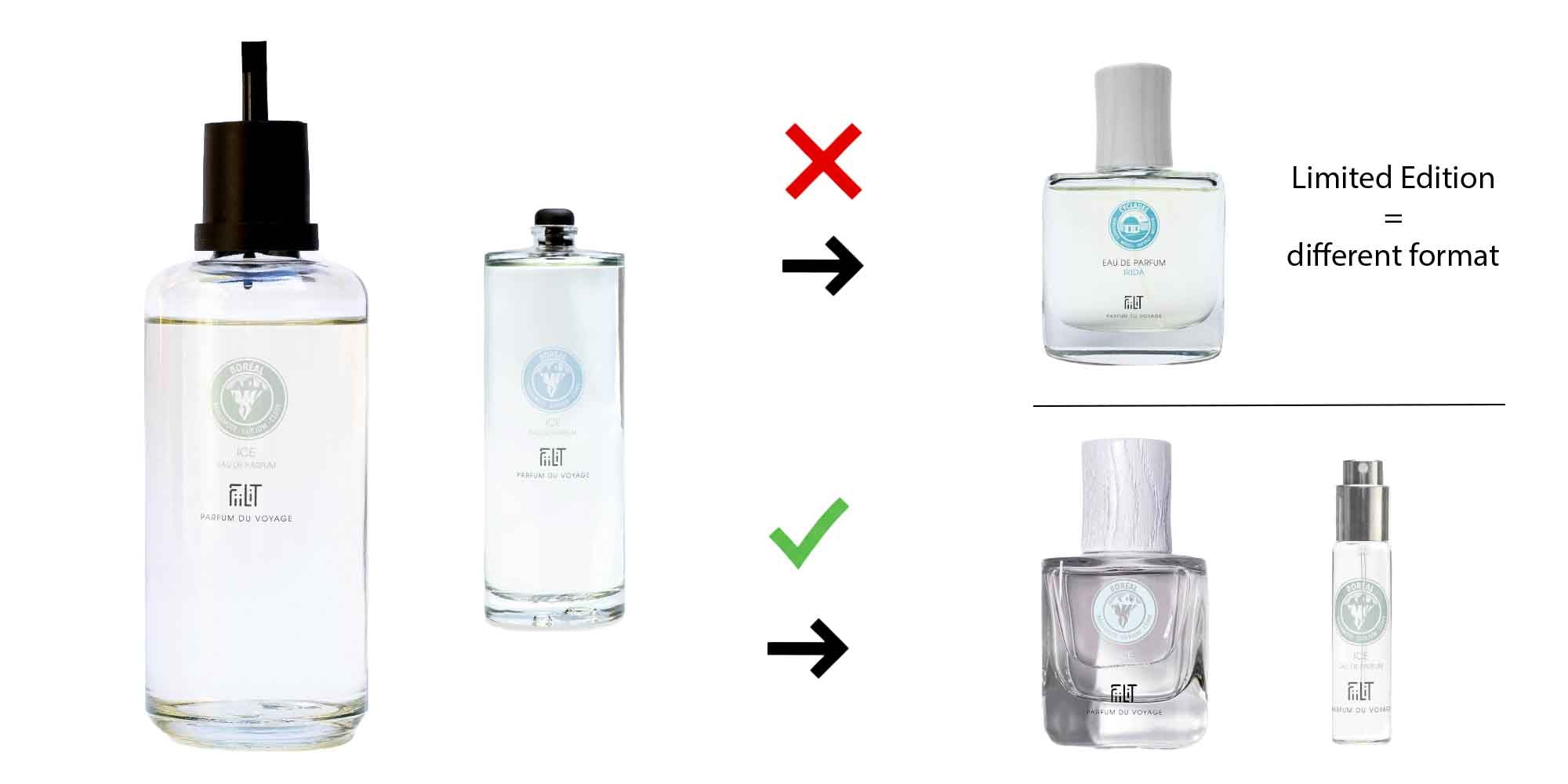
✅ La recharge est compatible avec :
❌ Non compatible avec :
C'EST VOTRE PREMIER ACHAT ?
Nous vous recommandons de commencer par un flacon de 50mL devissable (le premier format de ce parfum)
Sunny and exotic
The Olfactory Pyramid in Motion
From the soaring top notes to the depth of the base notes
Fragrance Accords
Chacun son histoire : tester le petit conteur
Découvrez les récits fascinants derrière chaque fragrance (caution : peut se tromper)
Prolonger le voyage avec les recharges pour plus d'écologie, d'économie et de plaisir.
NOTE: Refills come without a sprayer and require a refillable 50 ml or 11 ml bottle.
Recharge 200 mL – avec Embout Entonnoir Intégré
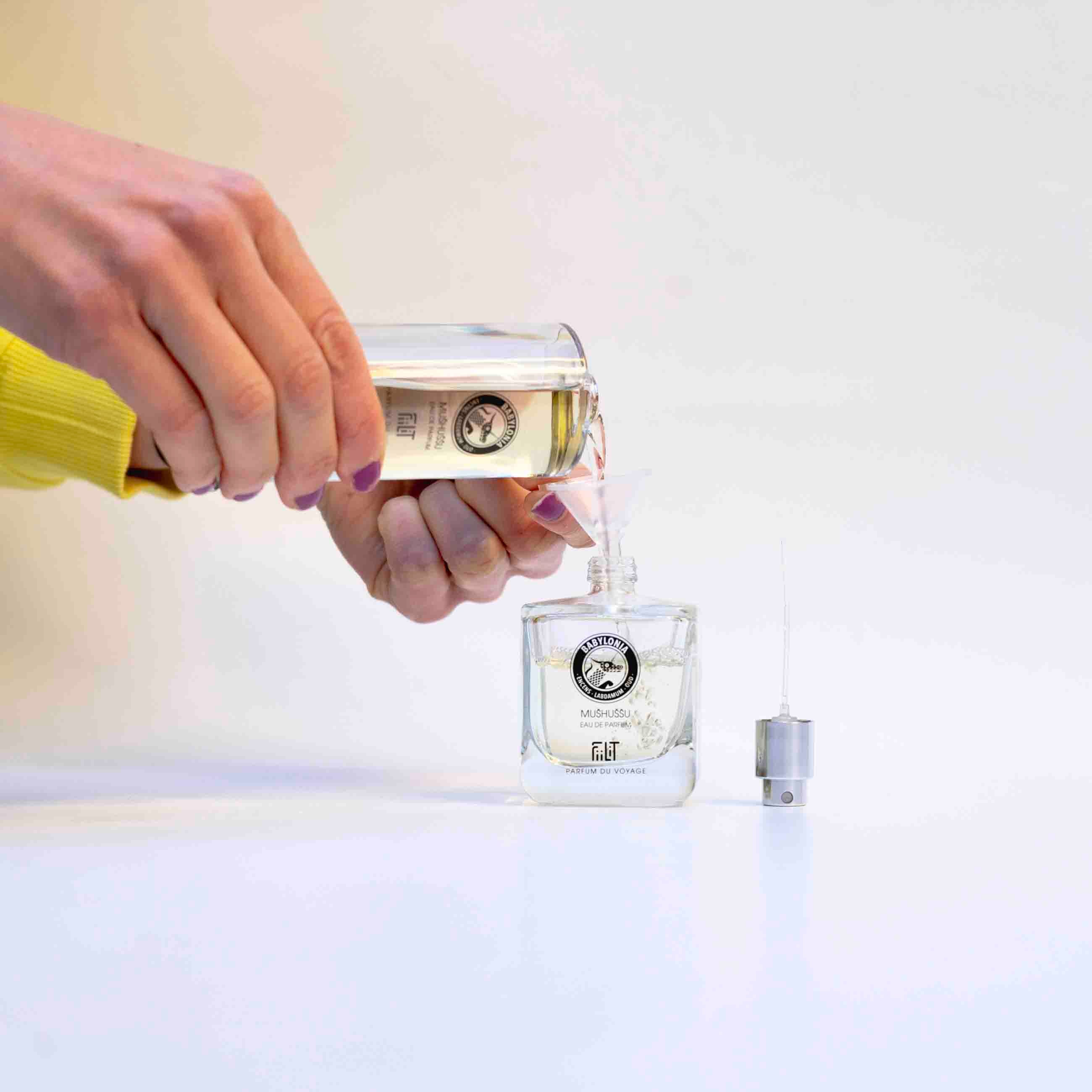
Recharge 100 mL – avec Entonnoir Fourni
Top notes: generally hesperidic (citrus) and aromatic families (e.g. orange, yuzu, eucalyptus). Their intensity is very high at 0 h and drops quickly after a few hours. This is the expected behaviour of these volatile notes, which define the first impression of the perfume.
Heart notes: generally floral, spicy or fruity families (e.g. fig leaf, cherry blossom, tuberose). Their intensity is moderate at first, peaks around 6 h, then gradually fades. They form the character and main theme of the perfume.
Base notes: generally woody, amber, leathery or chypre families (e.g. vetiver, vanilla, sandalwood, patchouli). They start with a low intensity that increases and stabilises to become dominant after 12 h and 24 h. They form the sillage and ensure the perfume's longevity.
Our perfumers pair the most volatile raw materials with base or structural notes to improve their natural longevity.
The notes of each Parfum du Voyage react differently on every skin, creating subtle or sometimes striking variations that reflect your individuality. When you wear one of our perfumes, you live a personal olfactory experience that no one else can copy.
Ingredients chosen one by one. Essential oils, absolutes, natural extracts: our perfumers in Grasse work with materials sourced at origin, from supply chains we know by name.
87% to 100% of natural origin. When a composition calls for it, a few high-quality synthetic molecules extend a note or sharpen its colour. They enhance nature, they never replace it.
A readable formula. The full ingredient list is on every product page: you know exactly what you wear.
One bottle for life. We are constantly working to reduce our impact: your 50 ml refills with our 100 ml and 200 ml refills. Keep the bottle, only buy the fragrance again.
La principale différence réside dans leur méthode de remplissage et leur facilité d'utilisation. Bien que les deux permettent de recharger vos flacons de 50mL et 11mL, leur conception est différente :
En résumé, les deux formats sont économiques et écologiques, mais la recharge de 200mL offre un confort d'utilisation supérieur grâce à son système de remplissage innovant.
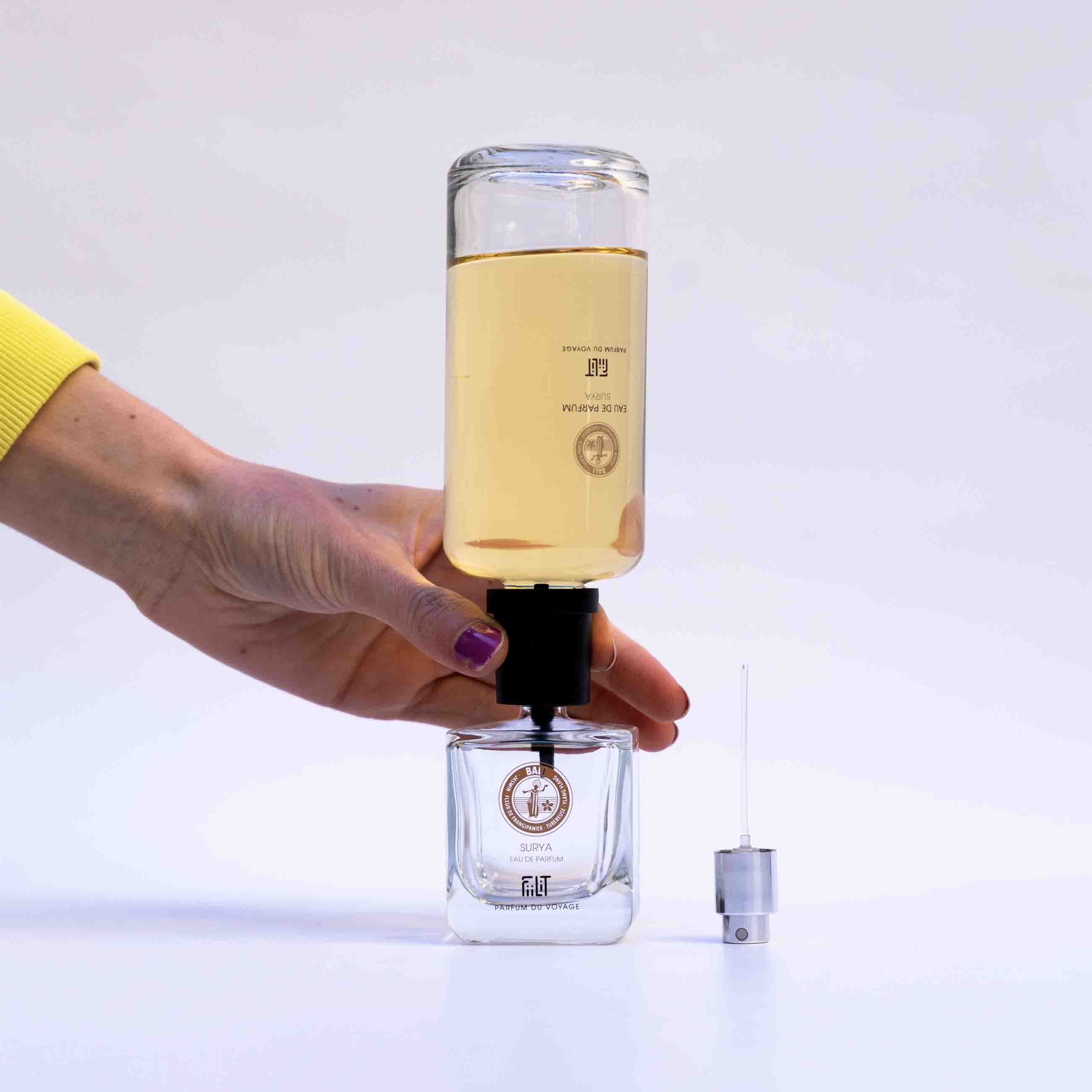
To fill the 11 ml travel bottle or the 50 ml bottle with a 200 ml refill, follow these steps:
1. Unscrew the pump of the refillable 50 ml or 11 ml bottle, counter-clockwise (to the left).
2. Screw the "funnel" tip of the refill onto the bottle to refill, clockwise.
3. Once screwed on tightly, the bottle fills by itself thanks to the air intake. If it does not fill immediately, shake the refill gently to help the perfume flow down. Wait until the bottle is full. When there are no more bubbles in the refill, filling is complete.
4. Unscrew the refill by its tip, holding it firmly.
5. Screw the pump back onto your bottle. You are ready to wear it.
Note: when handling the refill, take care not to unscrew the "funnel" tip from its 200 ml bottle.
Store your refill away from light and heat to preserve the quality of your perfume.
200 ml refill, built-in RT Twist tip:
- Very easy to use, anti-overflow system.
- Refills 11 ml and 50 ml bottles.
- Ideal for clean, quick refills.
- Economical and responsible format.
100 ml refill, with funnel:
- Also fills 11 ml and 50 ml bottles.
- Trickier to handle: higher risk of spilling with the funnel.
- Best if you are comfortable decanting by hand.
- Economical and responsible format.
Refills reduce your environmental impact while offering a durable, economical solution. A responsible way to enjoy your favourite fragrance to the full.
How many refills can I make? 200 ml ≈ 4×50 ml or 18×11 ml; 100 ml ≈ 2×50 ml or 9×11 ml.
To fill the 11 ml travel bottle or the 50 ml bottle with a 200 ml refill, follow these steps:
1. Unscrew the pump of the refillable 50 ml or 11 ml bottle, counter-clockwise (to the left).
2. Screw the "funnel" tip of the refill onto the bottle to refill, clockwise.
3. Once screwed on tightly, the bottle fills by itself thanks to the air intake. If it does not fill immediately, shake the refill gently to help the perfume flow down. Wait until the bottle is full. When there are no more bubbles in the refill, filling is complete.
4. Unscrew the refill by its tip, holding it firmly.
5. Screw the pump back onto your bottle. You are ready to wear it.
Note: when handling the refill, take care not to unscrew the "funnel" tip from its 200 ml bottle.
Store your refill away from light and heat to preserve the quality of your perfume.
200 ml refill, built-in RT Twist tip:
- Very easy to use, anti-overflow system.
- Refills 11 ml and 50 ml bottles.
- Ideal for clean, quick refills.
- Economical and responsible format.
100 ml refill, with funnel:
- Also fills 11 ml and 50 ml bottles.
- Trickier to handle: higher risk of spilling with the funnel.
- Best if you are comfortable decanting by hand.
- Economical and responsible format.
Refills reduce your environmental impact while offering a durable, economical solution. A responsible way to enjoy your favourite fragrance to the full.
How many refills can I make? 200 ml ≈ 4×50 ml or 18×11 ml; 100 ml ≈ 2×50 ml or 9×11 ml.
All of them, except the limited-edition 50 ml and the 1.5 ml sizes.
We carefully pack your perfumes as quickly as possible after your order (usually one working day). Once your parcel has shipped, you will receive an email to track it. Delivery time depends on your location (about 3 working days for France, 4 to 5 days for neighbouring countries, one week to 10 days for the rest of the EU and about 2 to 3 weeks for international destinations such as the US, Canada or South Korea).
Important note
We are a niche perfume house that cares deeply about the quality and originality of our creations. We believe perfumes are personal and unique expressions that can evoke intense, captivating emotions. This uniqueness can also mean that our fragrances do not suit every taste. We therefore recommend trying our products before buying, to find the perfumes that best match your personality and olfactory preferences. To discover them on your skin, try our Discovery Set.
Buyer protection
You have 14 days from receipt to return a product in its complete original packaging. You may open it to look at it, but not use it: if the contents have been used, taken out or refilled, the depreciation is deducted from the refund. Return costs are at your expense (tracked registered shipping, or a return label paid through a payment link we send you) and we refund you on receipt, including the initial delivery costs. Damaged or wrong product: send us a photo, and the return costs are then at our expense. Unsure? Add the 1.5 ml mini format to try it before using a full bottle. Learn more
All our eaux de parfum are unisex, 87% to 100% of natural origin.
Refillable bottles : 50 ml / 11 ml with wooden travel case / 11 ml on its own
The wooden travel case comes with its 11 ml fragrance.
Non-refillable bottles : limited-edition 50 ml and 100 ml
Made in : France
Vegan fragrance : yes, brand listed by PETA
Long-lasting on skin : yes
Readable formula : full ingredient list (INCI) on every product page
Composition : alcohol, essential oils, absolutes and natural extracts, completed in some fragrances by a few carefully chosen synthetic molecules
Concentration : eau de parfum
Age group : adult
Gender : unisex (for men and women)
Packaging : reusable and recyclable glass bottle, non-recyclable spray pump, ash-wood cap from France, Spain and Belgium, PEFC certified. The 11 ml bottle always comes inside the wooden travel case.

