Fragrance Accords
Spiritual and Leathery


MUSHUSSU - BABYLONIA Eau de Parfum


Pickup available at 8 rue de Paris
Usually ready in 4 hours
This creation evokes the hanging gardens of Babylon, watched over by the protective genius Mušhuššu.
The noble and powerful essence of Oud wood welcomes frosted mint leaves.
On a dark background of woods and spices, this fragrance possesses the wild intensity of an alliance between racy sensuality and intoxicating freshness.
Famille olfactive : Oriental / Woody & Spicy
L'évolution du parfum
Mushussu opens with a powerful and contrasting breath. The warm spices, Pepper and Nutmeg, are seized by the zesty freshness of Elemi and Mint. Quickly, the perfume reveals its sacred and mystical heart. The resinous and mineral wisps of Incense coil around the animalic and amber warmth of Labdanum. The trail settles in for hours, like an indelible imprint. Sandalwood brings its creamy softness, which polishes the woody, smoky, and animalic power of the legendary Oud Wood.
The black gold of the Malabar coast. Black pepper is a spice of striking freshness and vivacity. Its scent is pungent, woody, and slightly floral. It's the note that snaps and awakens the composition.
Origine & récolte
The journey takes us to the 'spice forests' of Kerala. The pepper vines climb the trees. The harvesting of the still-green peppercorns is done by hand, cluster by cluster. They are then dried in the sun, where they get their black color and develop their pungency.
History & Origins
Originating from the Malabar coast in India, pepper (Piper nigrum) is one of the oldest and most coveted spices in history. It was so precious in Antiquity and the Middle Ages that it was used as currency and nicknamed 'black gold'.
Uses of Yesterday and Today
Queen of spices in the kitchen, black pepper is a choice ingredient in perfumery to bring a spicy freshness and vibration to compositions, especially in the woody, chypre, and oriental families.
The Benefits of the Material
In Ayurvedic medicine, black pepper is used for its digestive, stimulating, and anti-inflammatory properties. It is also known to improve blood circulation.
Impact
The cultivation of pepper on tree stakes promotes agroforestry and biodiversity, while providing a sustainable source of income for local communities.
On the spice route, a sacred vine, Offers its black grains, a concentrated force. A pungent scent, a distinguished freshness, The beginning of a journey, a story started.
I used a supercritical CO2 extraction of black pepper. This modern technique captures the pungent and fresh sensation of freshly ground pepper, without the heavier, earthier side of the classic essential oil. It's a spicy, pure, and lasting freshness.
For a perfume inspired by Babylon, a crossroads of trade routes, Pepper was a must. It brings this spicy vibration and energy that evoke caravans laden with treasures. It's the note that sets the rhythm of the perfume.
The information is given for indicative purposes. A perfume is a cosmetic product. Cannot replace medical advice.
A fresh and surprising resin. Elemi offers a citrusy, peppery, and terpenic flight. It is a resinous top note that brings a lively, woody, and spicy freshness, very different from that of classic citrus fruits.
Origine & récolte
The journey takes us to the tropical forest of the Philippines. The harvesting of Elemi is an ancestral know-how. The collectors roam the forest and make precise incisions on the trees, from which a pale gum flows. This resin is then collected and distilled to extract the essential oil.
History & Origins
Elemi is the gum-resin produced by the Pili tree, a large tree native to the Philippines. Its name is said to come from an Arabic phrase meaning 'above and below', perhaps evoking its balancing virtues. It was used by the Egyptians for embalming.
Uses of Yesterday and Today
Used for centuries in traditional medicine and as incense, Elemi essential oil is now appreciated in perfumery for its peppery and resinous freshness, which provides an original alternative to classic citrus notes.
The Benefits of the Material
In aromatherapy, Elemi essential oil is used for its expectorant, antiseptic, and healing properties. It is also known to be a general tonic for the body and mind.
Impact
Supporting a sustainable Elemi supply chain means valuing a non-timber forest resource and offering an economic alternative to deforestation for local communities.
The sap of the sacred tree, a tear of light, A forest scent, a primary freshness. Peppery, lemony, a singular note, The breath of the jungle, which chases away chimeras.
I like Elemi for its vertical freshness. It has a very modern 'Indian ink' and black pepper aspect. In this composition, it serves to amplify the freshness of the incense and to create a vibrant and textured start, which is off the beaten path of citrus freshness.
Elemi is the surprise note in Mushussu. It brings a resinous and peppery freshness that creates a striking contrast with the warm spices and dark woods. It is a resin that has the vivacity of a spice, a duality that fascinates us.
The information is given for indicative purposes. A perfume is a cosmetic product. Elemi essential oil may contain allergens (limonene).
A warm, woody, and enveloping spice. Nutmeg offers a complex scent, at once spicy, dry, and slightly powdery. It is a note that brings instant warmth and sophistication.
Origine & récolte
The journey takes us to the Molucca Islands. The nutmeg tree produces a fruit resembling an apricot. When mature, it opens to reveal the nutmeg, surrounded by its mace, a bright red aril. The nut is then dried for several weeks before being distilled.
History & Origins
Originating from the Banda Islands in the Moluccas archipelago in Indonesia, nutmeg was one of the most expensive and coveted spices, leading to bloody trade wars between European colonial powers in the 17th century.
Uses of Yesterday and Today
Used in cooking to flavor both savory and sweet dishes, nutmeg is a choice ingredient in perfumery to bring a spicy and woody warmth to compositions, especially masculine and oriental ones.
The Benefits of the Material
In traditional medicine, nutmeg is used for its digestive, anti-inflammatory, and analgesic properties. It is also known to be a brain tonic.
Impact
Supporting these supply chains means preserving a unique agricultural heritage and providing stable incomes to local communities, thus combating deforestation.
On the spice islands, a golden-colored fruit, Hides a nut in its heart, a precious treasure. Its scent is a warmth, a comfort, The breath of volcanoes, a powerful accord.
Nutmeg is a spice of great elegance. I used an essence that highlights its woody and dry facets, rather than its culinary side. It blends perfectly with pepper and elemi to create a complex and multifaceted spicy start.
Nutmeg is the warm spice that links the freshness of the start with the warmth of the heart. It brings this woody and comforting facet that evokes the treasures of the Orient. It is a note that gives texture and depth to the composition.
The information is given for indicative purposes. A perfume is a cosmetic product. In high doses, nutmeg can be toxic. Its use in perfumery is safe.
A green, aromatic, and zesty freshness. Mint provides a striking, almost icy, flight that shakes up and energizes the warmer and darker notes of the composition. It is a note of contrast, unexpected and modern.
Origine & récolte
The journey takes us to the plains of Uttar Pradesh in India. Mint is harvested several times a year. The leaves are mown and then left to dry in the sun for a few hours before being distilled to extract the essential oil.
History & Origins
Mint is one of the oldest medicinal plants, used by the Egyptians, Greeks, and Romans for its digestive and refreshing virtues. There are many varieties, each with its own olfactory profile.
Uses of Yesterday and Today
From infusion to toothpaste, mint is ubiquitous. In perfumery, it is a classic of aromatic notes, bringing a lively freshness to masculine compositions and, more recently, a touch of bold modernity to feminine and unisex perfumes.
The Benefits of the Material
In aromatherapy, mint essential oil is used for its digestive, analgesic, and toning properties. It is known to relieve headaches and nausea.
Impact
Supporting these supply chains means encouraging more environmentally friendly agriculture and providing stable incomes to Indian agricultural communities.
A breath of frost in the heat of the temple, A green leaf that the spirit contemplates. A freshness that surprises, a powerful example, Of life that springs forth, simple and ample.
I used a spearmint essence (Mentha spicata), which is softer and less 'toothpaste-like' than peppermint. Its role is to bring an aromatic and vegetal freshness that illuminates the spices and resins, creating a start of great modernity.
Mint is the surprise element in Mushussu. In an oriental and woody perfume, it brings a vertical and unexpected freshness that creates an olfactory shock. It is this tension between hot and cold that makes the perfume so unique and memorable.
The information is given for indicative purposes. A perfume is a cosmetic product. Mint essential oil is powerful and should be used with caution.
Sacred tear of the desert trees, incense is one of the oldest materials in perfumery. Its scent is resinous, mineral, spicy, and slightly lemony. It is a note that elevates the spirit and brings a spiritual dimension and lasting freshness to the composition.
Origine & récolte
The harvesting of incense is an ancestral art. The harvesters make incisions in the bark of the Boswellia tree, which then 'weeps' tears of resin. After several weeks of drying on the tree, these tears are collected by hand. It is a story of patience, of respect for the tree, in one of the most hostile environments.
History & Origins
Incense, or Olibanum, is the aromatic resin produced by trees of the Boswellia genus, which grow in the arid regions of Africa and the Arabian Peninsula. It was one of the most precious products of Antiquity, at the heart of the 'Incense Route', and was worth more than gold. It was one of the gifts offered to the infant Jesus by the Magi.
Uses of Yesterday and Today
Burned in the religious rituals of almost all civilizations for millennia, incense is now a major ingredient in niche perfumery, sought after for its elegance, freshness, and spiritual dimension. It signs many woody and oriental creations.
The Benefits of the Material
In aromatherapy, incense essential oil is known for its anti-inflammatory, antiseptic, and expectorant properties. It is also used for its calming effects on the nervous system, helping to combat anxiety and stress.
Impact
Responsible sourcing of Boswellia is crucial for its survival. By supporting supply chains that promote reasoned harvesting and tree regeneration, we participate in the preservation of a unique species and ecosystem.
On the arid land, the wounded tree weeps, A golden resin, which soothes fears. Its scent is a smoke that rises to the heavens, A bridge between the earth and the world of the Gods.
I love incense for its duality: it is both a base note, very tenacious, and a top note, with its citrusy freshness. I used a distilled essential oil that highlights this zesty and mineral flight, to create a heart that breathes, that brings light and space to the composition.
Incense is the spiritual soul of Mushussu. It evokes the sacred smoke of the temples of Babylon. We chose an incense from Somalia, renowned for its purity, to bring this mystical dimension and this mineral freshness that runs through the perfume.
The information is given for indicative purposes. A perfume is a cosmetic product. Cannot replace medical advice.
The amber soul of the maquis. Labdanum is a resinous gum from the cistus plant. Its absolute is incredibly rich, with amber, animalic, leathery, woody, and balsamic notes. It is a powerful base note that brings intense warmth and sensuality.
Origine & récolte
The journey takes us to the arid hills of Andalusia. In summer, the cistus branches become covered with a sticky and fragrant gum. Harvesters roam the maquis with leather straps which they whip on the plants to collect the precious resin.
History & Origins
Labdanum is one of the oldest raw materials in perfumery. The Egyptians used it in their sacred incenses, notably Kyphi. The gum was collected by combing the fleece of goats that grazed on the cistus branches.
Uses of Yesterday and Today
From sacred perfume to a key ingredient in modern perfumery, labdanum is essential for recreating the 'amber' accord. It is a pillar of the chypre and oriental olfactory families.
The Benefits of the Material
In aromatherapy, labdanum is used for its healing and anti-infectious properties. Its scent is known for its relaxing virtues and for aiding meditation.
Impact
The valorization of wild cistus helps to maintain an economic activity in rural areas and to preserve the natural landscapes of southern Spain.
On the land of Andalusia, heated by the sun, The cistus sticks to the fingers, a scent like no other. Amber, animalic, a call to awaken The senses and desire, under a vermilion sky.
Labdanum is one of the pillars of amber accords. I used an absolute from Spain for its exceptional quality, with a very elegant leathery facet. It creates a perfect link between the incense of the heart and the precious woods of the base, bringing a warmth and complexity that unfolds slowly on the skin.
Labdanum is the amber and animalic heart of Mushussu. It brings this warmth and depth that evoke the opulent perfumes of ancient Mesopotamia. It is a characterful note, which gives the perfume its powerful and mystical signature.
The information is given for indicative purposes. A perfume is a cosmetic product. Cannot replace medical advice.
The wood of serenity. Sandalwood offers a woody scent of unique softness and smoothness, with milky, creamy, and comforting facets. It is an exceptional fixative that brings incomparable richness and roundness to a composition.
Origine & récolte
This is a human adventure, a meeting with the Kanak communities for whom sandalwood is a part of their heritage. It is the story of a trust agreement, where a company commits for decades, in exchange for access to a resource managed according to local customs and wisdom.
History & Origins
Used for millennia in India, Mysore sandalwood (*Santalum album*) has been a victim of its success. Over-exploitation has led to the development of sustainable cultivation chains, notably in New Caledonia with the endemic species *Santalum austrocaledonicum*, managed in partnership with the Kanak tribes.
Uses of Yesterday and Today
From sacred wood for rituals in the East, sandalwood has become a luxury ingredient in the West. Today, thanks to sustainable supply chains, natural sandalwood is experiencing a true renaissance in perfumery.
The Benefits of the Material
In aromatherapy, sandalwood is used for its sedative and relaxing properties, fighting against anxiety and insomnia. It is also recognized for its virtues on the skin, notably soothing and regenerating.
Impact
Choosing this sandalwood means investing in a conservation model that ensures the sustainability of the species for future generations and that values the traditional knowledge of indigenous peoples.
The heart of the old tree has kept the secret, Of a scent of silence, milky and discreet. No cry nor exuberance, just a perfect trail, That anchors the soul to the world, soothes and satisfies.
Sandalwood from New Caledonia is a marvel. It has this characteristic woody-milky signature, with great finesse. I use it to create a comfortable and addictive base, a second skin that extends the trail to infinity.
Sandalwood is the woody caress of Mushussu. Faced with the Mysore sandalwood crisis, we made the ethical choice to turn to a sustainable supply chain. This sandalwood provides the creamy and milky base that polishes the power of Oud and resins, for a trail of incomparable comfort and nobility.
The information is given for indicative purposes. A perfume is a cosmetic product. Cannot replace medical advice.
The wood of the gods. Oud is a dark, fragrant resin produced by Aquilaria trees when they are infected with a certain type of fungus. Its scent is of unparalleled complexity and power: woody, animalic, leathery, smoky, with amber and spicy facets. It is one of the most expensive and precious materials in perfumery.
Origine & récolte
The journey takes us to plantations in Laos. Trees are planted and cared for for several years. Then comes the crucial step of inoculation. It is then necessary to wait several more years for the tree to produce its precious resin. It is a story of science, patience, and a bet on the future.
History & Origins
Oud wood, or Agarwood, is mentioned in some of the oldest texts of humanity, including the Bible and Sanskrit texts. It is a legendary raw material in the Middle East and Asia, where it is burned as incense or used as an oil for perfuming.
Uses of Yesterday and Today
From the perfume of kings and sacred rituals, Oud conquered Western perfumery in the 2000s, creating a new family of 'oud-iental' perfumes. It is now a luxury ingredient, the signature of the most powerful and prestigious perfumes.
The Benefits of the Material
In traditional Asian medicine, Oud wood is used for its calming, anti-stress properties and to treat digestive and respiratory disorders.
Impact
Supporting plantation Oud supply chains means combating poaching and illegal trade that decimate the primary forests of Asia, and investing in a new green economy for local communities.
The wound of the tree is a gift from heaven, A black resin, an immortal perfume. Animalic and sacred, a carnal call, Oud is a mystery, an eternal treasure.
Oud is a legendary raw material, but difficult to master. It can devour everything in its path. My job was to sculpt it, to combine it with the softness of sandalwood and benzoin to polish its rough edges and keep only its woody nobility and its animalic warmth. It is the foundation on which all the power of the perfume rests.
Oud is the ultimate note of luxury and mystery. For Mushussu, we wanted an Oud that was powerful but not brutal. We chose a quality from sustainable plantations, which offers a woody and leathery profile of great elegance, without the overly 'cheesy' notes of some wild ouds.
The information is given for indicative purposes. A perfume is a cosmetic product. Cannot replace medical advice.
96% d'origine naturelle.
Liste des ingrédients (INCI) : Alcohol Denat**, Parfum(Fragrance), Aqua(Water), Limonene*, Linalool*, Eugenol*, Cinnamal*, Coumarin*, Citral*, Benzyl Benzoate*
Un geste pour l'écologie, l'économie et le plaisir. Les recharges (100mL et 200mL) vous permettent de remplir à l'infini votre flacon et de ne jamais manquer de votre sillage signature.
Pour une expérience parfaite, assurez-vous d'avoir le bon équipement !
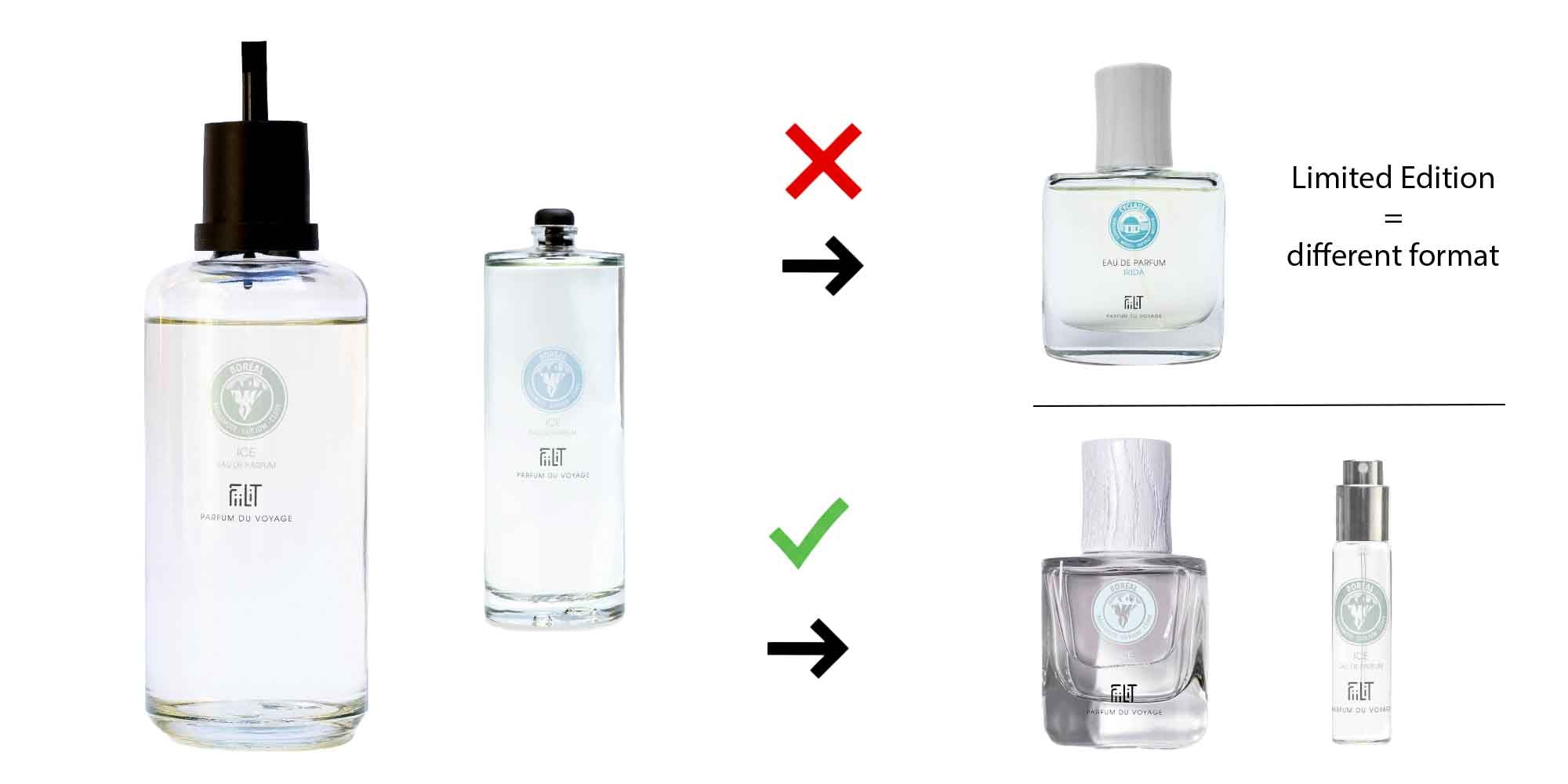
✅ La recharge est compatible avec :
❌ Non compatible avec :
C'EST VOTRE PREMIER ACHAT ?
Nous vous recommandons de commencer par un flacon de 50mL devissable (le premier format de ce parfum)
Spiritual and Leathery
The Olfactory Pyramid in Motion
From the soaring top notes to the depth of the base notes
Fragrance Accords
Chacun son histoire : tester le petit conteur
Découvrez les récits fascinants derrière chaque fragrance (caution : peut se tromper)
Prolonger le voyage avec les recharges pour plus d'écologie, d'économie et de plaisir.
NOTE: Refills come without a sprayer and require a refillable 50 ml or 11 ml bottle.
Recharge 200 mL – avec Embout Entonnoir Intégré
Recharge 100 mL – avec Entonnoir Fourni
Top notes: generally hesperidic (citrus) and aromatic families (e.g. orange, yuzu, eucalyptus). Their intensity is very high at 0 h and drops quickly after a few hours. This is the expected behaviour of these volatile notes, which define the first impression of the perfume.
Heart notes: generally floral, spicy or fruity families (e.g. fig leaf, cherry blossom, tuberose). Their intensity is moderate at first, peaks around 6 h, then gradually fades. They form the character and main theme of the perfume.
Base notes: generally woody, amber, leathery or chypre families (e.g. vetiver, vanilla, sandalwood, patchouli). They start with a low intensity that increases and stabilises to become dominant after 12 h and 24 h. They form the sillage and ensure the perfume's longevity.
Our perfumers pair the most volatile raw materials with base or structural notes to improve their natural longevity.
The notes of each Parfum du Voyage react differently on every skin, creating subtle or sometimes striking variations that reflect your individuality. When you wear one of our perfumes, you live a personal olfactory experience that no one else can copy.
Ingredients chosen one by one. Essential oils, absolutes, natural extracts: our perfumers in Grasse work with materials sourced at origin, from supply chains we know by name.
87% to 100% of natural origin. When a composition calls for it, a few high-quality synthetic molecules extend a note or sharpen its colour. They enhance nature, they never replace it.
A readable formula. The full ingredient list is on every product page: you know exactly what you wear.
One bottle for life. We are constantly working to reduce our impact: your 50 ml refills with our 100 ml and 200 ml refills. Keep the bottle, only buy the fragrance again.
La principale différence réside dans leur méthode de remplissage et leur facilité d'utilisation. Bien que les deux permettent de recharger vos flacons de 50mL et 11mL, leur conception est différente :
En résumé, les deux formats sont économiques et écologiques, mais la recharge de 200mL offre un confort d'utilisation supérieur grâce à son système de remplissage innovant.
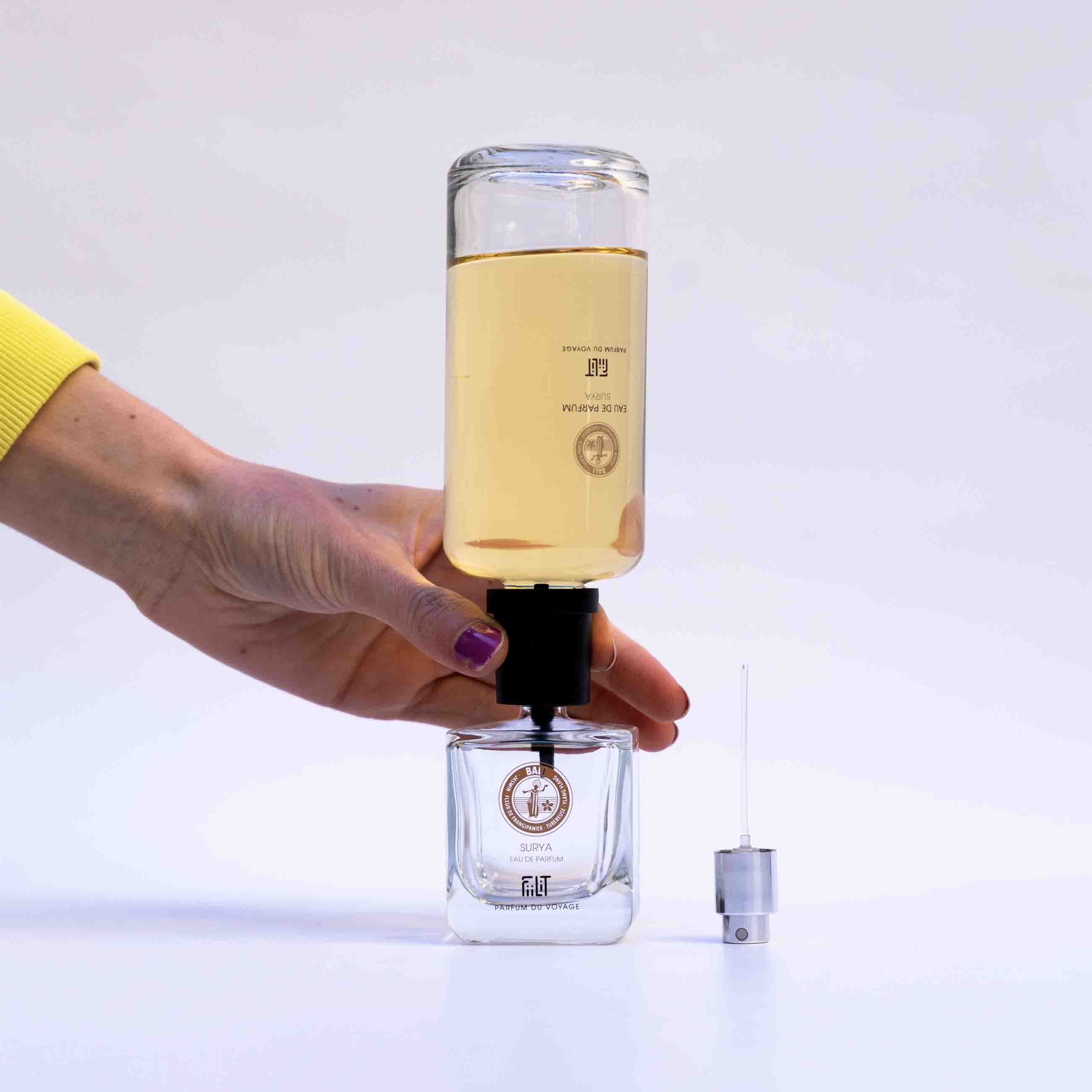
To fill the 11 ml travel bottle or the 50 ml bottle with a 200 ml refill, follow these steps:
1. Unscrew the pump of the refillable 50 ml or 11 ml bottle, counter-clockwise (to the left).
2. Screw the "funnel" tip of the refill onto the bottle to refill, clockwise.
3. Once screwed on tightly, the bottle fills by itself thanks to the air intake. If it does not fill immediately, shake the refill gently to help the perfume flow down. Wait until the bottle is full. When there are no more bubbles in the refill, filling is complete.
4. Unscrew the refill by its tip, holding it firmly.
5. Screw the pump back onto your bottle. You are ready to wear it.
Note: when handling the refill, take care not to unscrew the "funnel" tip from its 200 ml bottle.
Store your refill away from light and heat to preserve the quality of your perfume.
200 ml refill, built-in RT Twist tip:
- Very easy to use, anti-overflow system.
- Refills 11 ml and 50 ml bottles.
- Ideal for clean, quick refills.
- Economical and responsible format.
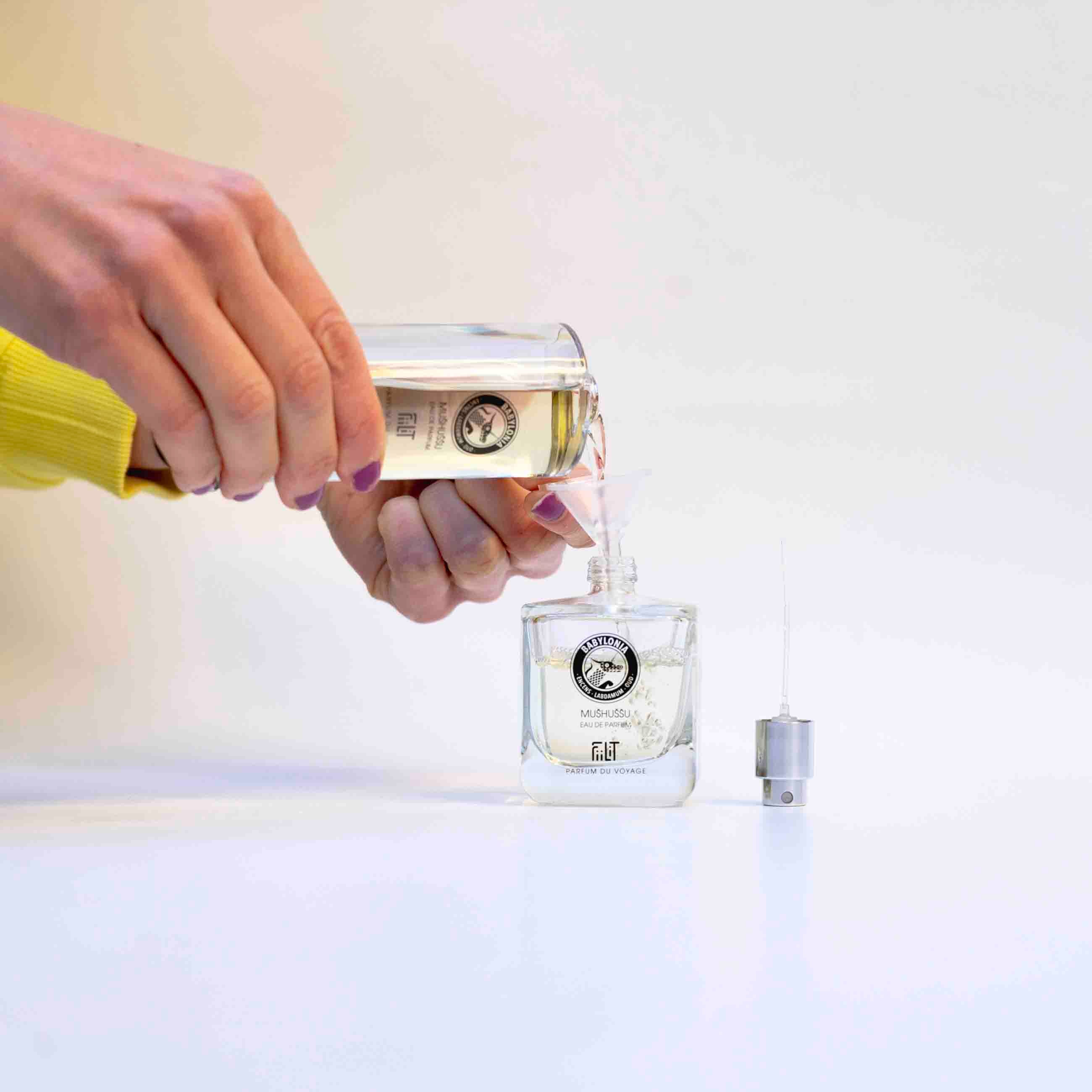
100 ml refill, with funnel:
- Also fills 11 ml and 50 ml bottles.
- Trickier to handle: higher risk of spilling with the funnel.
- Best if you are comfortable decanting by hand.
- Economical and responsible format.
Refills reduce your environmental impact while offering a durable, economical solution. A responsible way to enjoy your favourite fragrance to the full.
How many refills can I make? 200 ml ≈ 4×50 ml or 18×11 ml; 100 ml ≈ 2×50 ml or 9×11 ml.
To fill the 11 ml travel bottle or the 50 ml bottle with a 200 ml refill, follow these steps:
1. Unscrew the pump of the refillable 50 ml or 11 ml bottle, counter-clockwise (to the left).
2. Screw the "funnel" tip of the refill onto the bottle to refill, clockwise.
3. Once screwed on tightly, the bottle fills by itself thanks to the air intake. If it does not fill immediately, shake the refill gently to help the perfume flow down. Wait until the bottle is full. When there are no more bubbles in the refill, filling is complete.
4. Unscrew the refill by its tip, holding it firmly.
5. Screw the pump back onto your bottle. You are ready to wear it.
Note: when handling the refill, take care not to unscrew the "funnel" tip from its 200 ml bottle.
Store your refill away from light and heat to preserve the quality of your perfume.
200 ml refill, built-in RT Twist tip:
- Very easy to use, anti-overflow system.
- Refills 11 ml and 50 ml bottles.
- Ideal for clean, quick refills.
- Economical and responsible format.
100 ml refill, with funnel:
- Also fills 11 ml and 50 ml bottles.
- Trickier to handle: higher risk of spilling with the funnel.
- Best if you are comfortable decanting by hand.
- Economical and responsible format.
Refills reduce your environmental impact while offering a durable, economical solution. A responsible way to enjoy your favourite fragrance to the full.
How many refills can I make? 200 ml ≈ 4×50 ml or 18×11 ml; 100 ml ≈ 2×50 ml or 9×11 ml.
All of them, except the limited-edition 50 ml and the 1.5 ml sizes.
We carefully pack your perfumes as quickly as possible after your order (usually one working day). Once your parcel has shipped, you will receive an email to track it. Delivery time depends on your location (about 3 working days for France, 4 to 5 days for neighbouring countries, one week to 10 days for the rest of the EU and about 2 to 3 weeks for international destinations such as the US, Canada or South Korea).
Important note
We are a niche perfume house that cares deeply about the quality and originality of our creations. We believe perfumes are personal and unique expressions that can evoke intense, captivating emotions. This uniqueness can also mean that our fragrances do not suit every taste. We therefore recommend trying our products before buying, to find the perfumes that best match your personality and olfactory preferences. To discover them on your skin, try our Discovery Set.
Buyer protection
You have 14 days from receipt to return a product in its complete original packaging. You may open it to look at it, but not use it: if the contents have been used, taken out or refilled, the depreciation is deducted from the refund. Return costs are at your expense (tracked registered shipping, or a return label paid through a payment link we send you) and we refund you on receipt, including the initial delivery costs. Damaged or wrong product: send us a photo, and the return costs are then at our expense. Unsure? Add the 1.5 ml mini format to try it before using a full bottle. Learn more
All our eaux de parfum are unisex, 87% to 100% of natural origin.
Refillable bottles : 50 ml / 11 ml with wooden travel case / 11 ml on its own
The wooden travel case comes with its 11 ml fragrance.
Non-refillable bottles : limited-edition 50 ml and 100 ml
Made in : France
Vegan fragrance : yes, brand listed by PETA
Long-lasting on skin : yes
Readable formula : full ingredient list (INCI) on every product page
Composition : alcohol, essential oils, absolutes and natural extracts, completed in some fragrances by a few carefully chosen synthetic molecules
Concentration : eau de parfum
Age group : adult
Gender : unisex (for men and women)
Packaging : reusable and recyclable glass bottle, non-recyclable spray pump, ash-wood cap from France, Spain and Belgium, PEFC certified. The 11 ml bottle always comes inside the wooden travel case.

