Fragrance Accords
Balance between cool and hot


IRIDA - CYCLADES Eau de Parfum


Pickup available at 8 rue de Paris
Usually ready in 4 hours
In this evolving fragrance, the luminous freshness of petitgrain and bergamot evokes the sea air of a Mediterranean morning.
The full-bodied earthy notes of myrrh and amber recall the sun on the skin.
While the elegance of patchouli, its fiery power, balances the elements in this invocation to Irida, the Greek goddess of the rainbow connecting sky and earth.
Dare a fragrance that connects your dreams to reality.
Famille olfactive : Amber / Citrus, woody, amber, floral
L'évolution du parfum
Irida opens with a dazzling and natural light. The citrus freshness of Bergamot, Neroli, and Petit Grain is immediately captured by the intense greenness and resinous bitterness of Mastic. The heart of the perfume reveals a softer, more powdery facet, where Violet Leaf brings a vegetal and earthy sensation. The trail finally unfolds, dry and mineral. Myrrh, with its balsamic freshness, dialogues with the woody and smoky notes of Papyrus and the clean, earthy depth of Patchouli, leaving a sophisticated and lasting impression.
The green gold of Calabria. Bergamot is the citrus of elegance par excellence. More floral and complex than a lemon, it brings a sparkling, zesty, and slightly bitter opening that illuminates the richest compositions.
Origine & récolte
The journey takes us to the Ionian coast of Calabria, where bergamot orchards stretch as far as the eye can see. The harvest takes place in winter. The fruits are then cold-pressed to extract the precious essence. It is a story of terroir, where the soil, the sun, and the sea breeze combine to create a citrus with an inimitable scent.
History & Origins
The bergamot tree (Citrus bergamia) is a mysterious tree, probably resulting from a cross between the lemon tree and the bitter orange tree. It owes its name to the city of Bergamo in Lombardy, where it was allegedly first cultivated. Today, more than 90% of the world's production comes from a narrow coastal strip in Calabria, Italy.
Uses Then and Now
Made famous in the 17th century by Eau de Cologne, bergamot is also the aroma that flavors the famous Earl Grey tea. In perfumery, it is an almost universal ingredient, used in all olfactory families to bring freshness and radiance.
The Material's Benefits
In aromatherapy, bergamot essential oil is widely used for its calming and sedative properties on the nervous system. It is renowned for combating stress, anxiety, and sleep disorders.
Impact
Supporting bergamot cultivation in Calabria means preserving a unique agricultural heritage and landscape, as well as ancestral know-how.
Facing the Strait of Messina, the Italian sun. The citrus is a treasure, a sweet madness. Its scent is a smile, a polished freshness, The promise of joy, of an embellished day.
I used a very high-quality bergamot essence, stripped of its furanocoumarins to avoid any risk of photosensitization. What I like about it is its complexity: it is citrusy, but also floral like petitgrain, and spicy like pepper. It sets the 'keynote' of the perfume's elegance.
For Irida, a pure, almost blinding light was needed, like that of the Cyclades. Calabrian Bergamot was an obvious choice. It brings that zesty and sunny freshness that sets the tone of the perfume: a raw and natural elegance.
The information is provided for indicative purposes. A perfume is a cosmetic product. Untreated bergamot essential oil is photosensitizing. We use a quality that is free of it.
Distilled from the bitter orange blossom, Neroli is floral, fresh, green, and slightly bitter. It is the light of the perfume, the spring freshness of the orange groves of Cap Bon.
Origine & récolte
Our journey takes us to the Cap Bon region in Tunisia, where, in spring, the air is fragrant with orange blossom. Witnessing the manual harvest, a precise ballet where each flower is picked one by one, is to touch the preciousness and ancestral know-how of this material.
History & Origins
Neroli owes its name to Anne-Marie Orsini, Duchess of Bracciano and Princess of Nerola (Italy) who, in the 17th century, launched the fashion of perfuming her gloves and her bath with the essence of bitter orange blossom. This perfume then became synonymous with aristocratic elegance.
Uses Then and Now
Once the perfume of royal courts, Neroli is a pillar of luxury perfumery and Eaux de Cologne. The floral water (hydrosol) of orange blossom is widely used in pastry and cosmetics for its soothing properties.
The Material's Benefits
Queen of aromatherapy, Neroli essential oil is a powerful nervous system rebalancer. It is used to calm anxiety, panic attacks, and stress, and to promote restful sleep.
Impact
The cultivation of bitter orange trees in orchards helps to combat soil erosion and maintain biodiversity-rich ecosystems, home to many pollinating insects.
In the gardens of Nabeul, under a clear sky, Each flower is a star, picked by hand. Its white and green scent, fleeting and peerless, Is a princess's sigh, a divine breath.
Neroli is a demanding material. I chose a quality from Tunisia for its particularly floral and less citrusy facet than other origins. My intention was to capture the vegetal freshness of the flower, to create a contrast with the warmth of the absolute in the heart.
Neroli is the light of Mazhar. It brings that floral and fresh burst that evokes the morning dew on orange blossoms. We chose a Tunisian 'Fair For Life' certified source for its exceptional quality and its commitment to the communities of women pickers.
The information is provided for indicative purposes. A perfume is a cosmetic product. Neroli essential oil contains allergens (linalool, limonene, geraniol). Cannot replace medical advice.
The green soul of the bitter orange tree. Distilled from the leaves and twigs of the bitter orange, Petit Grain offers a green, citrusy, and woody freshness, with an elegant bitterness. It is a lively and zesty note that brings character and structure.
Origine & récolte
The journey takes us to the vast plains of Paraguay. The cultivation of the bitter orange tree for Petit Grain is a traditional activity. The twigs are cut and then distilled on-site, often in mobile stills that move from plantation to plantation. It is a story of rural know-how and resilience.
History & Origins
The term 'Petitgrain' originally referred to the essential oil extracted from the small green fruits (small grains) of the bitter orange tree. By extension, the name remained to designate essential oils from the distillation of leaves and twigs of various citrus fruits. Paraguay has become the world's largest producer of Petit Grain Bigarade.
Uses Then and Now
Traditionally used in Eaux de Cologne for its lively freshness, Petitgrain is now a key ingredient for bringing a green, natural, and complex facet to floral and citrus compositions. The valorization of leaves makes it an example of a circular economy.
The Material's Benefits
In aromatherapy, Petit Grain Bigarade essential oil is a powerful anti-stress agent. It is used to calm anxiety, nervousness, and to combat insomnia. It is also an excellent skin regulator.
Impact
Supporting this industry helps to combat deforestation in Paraguay and ensures stable incomes for thousands of small producer families.
In the plains of Paraguay, the tree is generous, It offers its flower, its fruit, and its precious wood. The crushed leaf releases a sharp scent, The sap of the orange tree, a bold breath.
Paraguayan Petit Grain is a classic that I adore. It has a very direct power and freshness. I used it for its ability to 'cleanse' the olfactory palette and to bring a green tension that balances the roundness of the other notes. It's a structural note, essential to the balance of a modern chypre.
Petit Grain is the touch of aromatic greenness in Irida. It complements the freshness of bergamot and neroli with a more woody and bitter facet, which links to the resinous notes of the heart. It's the note that gives the composition its edge.
The information is provided for indicative purposes. A perfume is a cosmetic product. Cannot replace medical advice.
The scent of the Mediterranean maquis. The mastic tree is a shrub whose twigs are distilled to obtain an essence with a green, intense, and very characteristic scent. Its notes are earthy, bitter, with a 'hot dust' facet that evokes the sun-drenched paths of the Cyclades.
Origine & récolte
The journey takes us to the island of Chios. The mastic harvest, the 'kentima', is an immutable ritual. From July to September, the producers 'embroider' the soil and incise the tree's bark, which then weeps its tears of resin. It is a story of patience, of precise gestures passed down from generation to generation.
History & Origins
The mastic tree (Pistacia lentiscus) is a typical shrub of the Mediterranean basin. Its resin, called 'mastic', has been the specialty of the Greek island of Chios since antiquity, where it benefits from a PDO. It was used for its medicinal properties and to freshen the breath.
Uses Then and Now
While the resin (Chios mastic) is still used in confectionery and medicine, the essential oil from the twigs is increasingly prized in perfumery for its unique green signature, which brings a natural and wild touch to creations.
The Material's Benefits
In aromatherapy, mastic essential oil is renowned for its powerful decongestant properties for the venous and lymphatic systems. It is used to treat varicose veins, heavy legs, and cellulite.
Impact
Supporting the Chios Mastic industry means preserving a unique ecosystem and culture, recognized as an Intangible Cultural Heritage of Humanity by UNESCO.
On the arid land, under the burning sun, The tenacious shrub offers its powerful scent. A bitter greenness, a striking breath, The soul of the maquis, wild and captivating.
Mastic is an incredible raw material for creating original green notes. It has remarkable power and tenacity. I used it to bring a texture and bitterness that structure the entire composition, and to create a link between the freshness of the citruses and the depth of the base notes.
Mastic is the signature of Irida. It's a bold note, one that doesn't leave you indifferent. It brings that arid greenness and bitterness that are at the heart of the Cyclades' inspiration. It's the scent of raw, uncompromising nature.
The information is provided for indicative purposes. A perfume is a cosmetic product. Cannot replace medical advice.
A green, earthy, and powdery note, evoking the smell of damp undergrowth after the rain. As violet leaf absolute is very expensive and powerful, this accord is an artistic reconstruction that captures its most vegetal and least floral facet, bringing a touch of softness and mystery.
After the rain, the forest awakens, The violet leaf on the ground marvels. Its scent is a secret, a crimson confidence, A terrestrial freshness that brightens the soul.
I built this accord to bring a powdery texture and a sensation of vegetal moisture. I used molecules like Undecavertol for its green pear and violet note, and a touch of ionones for the powdery and woody aspect, to create an illusion of natural violet leaf, but more luminous and easier to wear.
The violet leaf is the unexpected touch of softness in Irida. It brings a powdery and slightly aqueous facet that softens the bitterness of the mastic and the dryness of the woods. It is a poetic note, evoking a hidden flower in the maquis.
A sacred resin with a mystical and enchanting scent. Myrrh offers a balsamic fragrance, with licorice-like, aniseed facets, and a woody and spicy warmth. It is a base note of great depth, which brings a spiritual dimension and a dark sensuality.
Origine & récolte
The journey takes us to the arid regions of the Horn of Africa. Harvesting myrrh is hard work, carried out by nomadic communities who know the secrets of each tree. They incise the bark and return several weeks later to collect the hardened resin 'tears'.
History & Origins
Myrrh is, along with frankincense, one of the oldest resins used by man. It was a precious commodity in antiquity, used by the Egyptians for embalming and by many cultures for religious rituals. It was one of the three gifts offered by the Magi.
Uses Then and Now
From a sacred perfume and ancient remedy, myrrh has become a luxury raw material in perfumery, essential to amber and oriental accords for its warmth, depth, and sensuality.
The Material's Benefits
In traditional medicine, myrrh is used for its powerful antiseptic, anti-inflammatory, and healing properties, especially for oral and skin conditions.
Impact
The economic valorization of myrrh provides a crucial source of income for populations in very arid regions and contributes to the preservation of fragile ecosystems.
The tear of the tree, a pearl of blood, A perfume for kings, since the dawn of time. Balsamic, licorice-like, a warmth that takes its time, A journey to the sacred, a moment out of time.
I used a myrrh essence obtained by distillation, which highlights its fresh, aniseed, and licorice-like top notes, rather than the resinoid which is heavier and sweeter. This allows for the creation of a balsamic base that remains vibrant and luminous, in perfect harmony with the incense.
Myrrh is the spiritual and mysterious note of Irida. It brings that balsamic warmth and depth that contrast with the bright light of the opening. It is a resin that has a history, a soul, and that gives the perfume its sacred and timeless character.
The information is provided for indicative purposes. A perfume is a cosmetic product. Cannot replace medical advice.
A woody, dry, earthy, and smoky note, evoking the smell of ancient scrolls and roots. Papyrus, or Cypriol, is a characterful note that brings a very contemporary woody dimension, far from classic woody notes.
Origine & récolte
The journey takes us to India, where Cypriol roots are harvested in wetlands. After harvesting, they are washed, dried, and distilled to extract an essential oil with a powerful and complex scent.
History & Origins
Cypriol, or Nagarmotha (Cyperus scariosus), is a herbaceous plant that grows in India. Although it is called 'Papyrus' in perfumery for its smell of old paper, it has no botanical link with the Egyptian papyrus. Its roots have been used for centuries in Ayurvedic medicine.
Uses Then and Now
Used in traditional Indian medicine, Cypriol has become a raw material of choice for perfumers in search of original, dry, and smoky woody notes. It is a pillar of modern woody and leathery perfumes.
The Material's Benefits
In Ayurvedic medicine, Cypriol (Nagarmotha) is used for its digestive, diuretic properties and to treat fever and skin conditions.
Impact
The valorization of this root provides a sustainable source of income for rural communities in India.
On the banks of the Ganges, the root awaits, A scent of earth, smoke, and time. A wood that is not wood, a surprising breath, The memory of papyrus, a troubling echo.
Cypriol, which is called Papyrus in perfumery, is a fascinating raw material. It has the power of patchouli but with a more smoky and less chocolatey facet. I used it to create a dry and vibrant woody accord, which reinforces the minerality of the incense and myrrh.
Papyrus is the unexpected woody note of Irida. It brings that dry, smoky, and almost leathery facet that gives the perfume's base its very particular character. It is a note that evokes the arid earth and the wisdom of ancient texts.
The information is provided for indicative purposes. A perfume is a cosmetic product. Cannot replace medical advice.
Far from the reductive cliché of the 60s, patchouli is a note of abyssal depth. Its scent is that of damp earth after the rain, a dark and sensual wood that can, thanks to the perfumer's know-how, transform into an elegant, clean signature, with hints of bitter cocoa. It is one of the most charismatic and structuring materials in the palette.
Origine & récolte
The journey for patchouli takes us to the rural villages of Sulawesi. There, patchouli is not an industrial crop, but a family affair. Behave Sourcing immerses itself in this reality to build partnerships of trust, where ancestral know-how meets sustainable practices to create an exceptional raw material.
History & Origins
Originally from Southeast Asia, patchouli traveled west along the Silk Road, where it was used to protect precious cashmere shawls from moths. Its scent thus became, in Europe, synonymous with luxury and exoticism, before being adopted by the hippie movement.
Uses Then and Now
From an insect repellent, patchouli has become indispensable to modern perfumery. It is an exceptional fixative and the cornerstone of the chypre, oriental, and woody families. Technological advances now make it possible to obtain purified fractions offering an infinite palette of nuances.
The Material's Benefits
In aromatherapy, patchouli is recognized for its balancing and soothing effect. It is used to relieve stress and anxiety. on the skin, it has anti-inflammatory, healing, and antiseptic properties.
Impact
The story of patchouli is one of community empowerment. By supporting a supply chain that offers fair prices and continuous training, we help create stable incomes that reduce pressure on forests.
In the damp shade where the jungle breathes, The leaf awaits, a secret that a long time desires. Fermented, distilled, its dark soul stretches, The earth becomes perfume, a powerful empire.
Patchouli is an architect. I don't use it for its scent alone, but for the structure and depth it gives to a composition. It's a dark and velvety backdrop that brings out the light of a rose or the warmth of an amber. Modern fractions like 'Patchouli Heart' are a revolution: they give me the power of its tenacity and richness without the dusty facets.
Patchouli is the backbone of Patchilai. We wanted to reveal its duality: its earthy soul and its modern sophistication. That's why we chose a 'Patchouli Heart' from our partner Behave Sourcing, a fraction obtained by molecular distillation. This technology allows us to sculpt the scent, to soften its camphorated notes to keep only its woody-cocoa heart, incredibly chic and contemporary.
The information is provided for indicative purposes. A perfume is a cosmetic product and cannot replace medical advice.
87% d'origine naturelle.
Liste des ingrédients (INCI) : Alcohol denat**, parfum(fragrance), aqua(water), linalool*, limonene*, alpha-isomethyl ionone, geraniol*, benzyl benzoate, citral*, benzyl alcohol, citronellol*
Un geste pour l'écologie, l'économie et le plaisir. Les recharges (100mL et 200mL) vous permettent de remplir à l'infini votre flacon et de ne jamais manquer de votre sillage signature.
Pour une expérience parfaite, assurez-vous d'avoir le bon équipement !
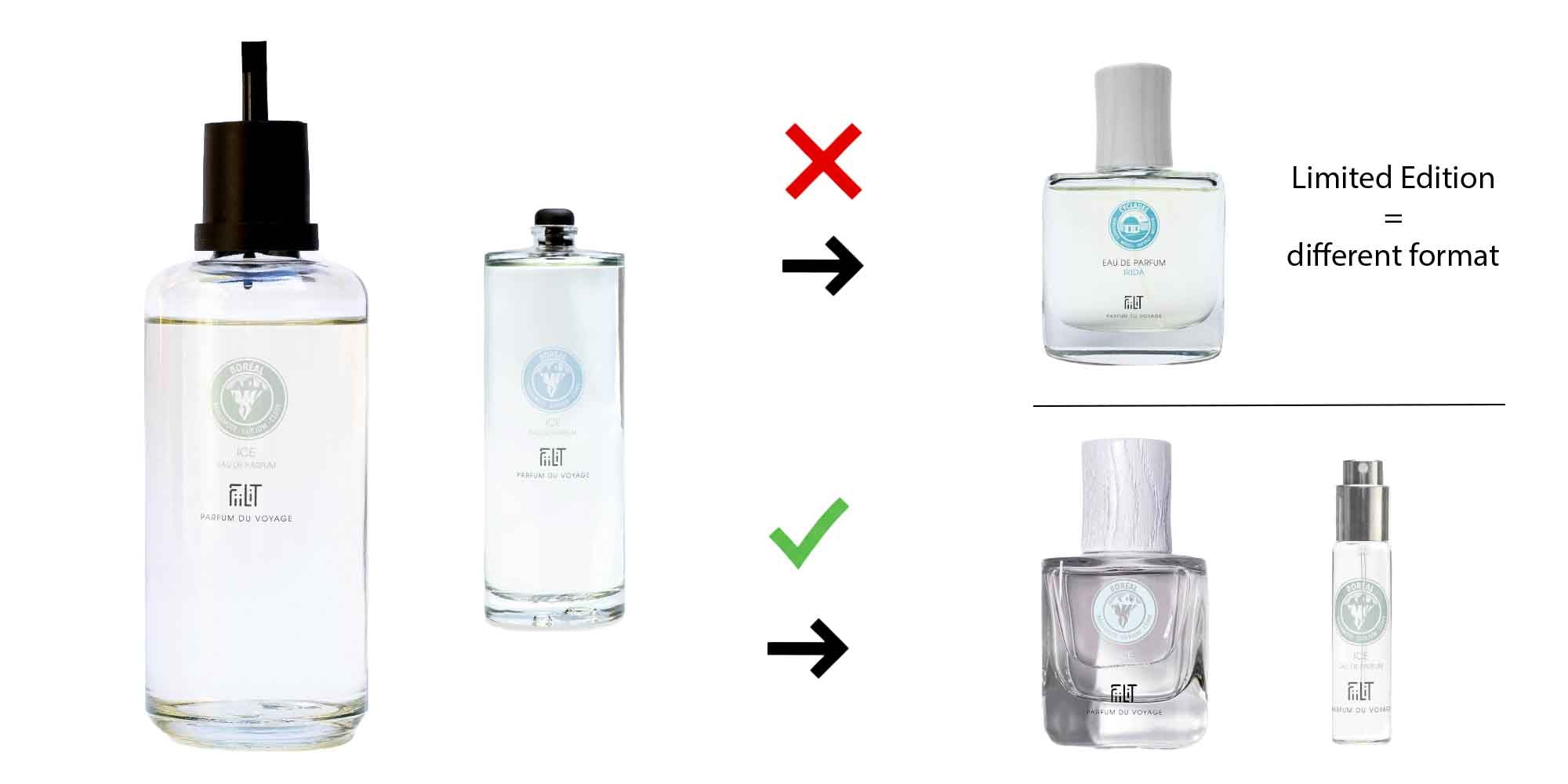
✅ La recharge est compatible avec :
❌ Non compatible avec :
C'EST VOTRE PREMIER ACHAT ?
Nous vous recommandons de commencer par un flacon de 50mL devissable (le premier format de ce parfum)
Balance between cool and hot
The Olfactory Pyramid in Motion
From the soaring top notes to the depth of the base notes
Fragrance Accords
Chacun son histoire : tester le petit conteur
Découvrez les récits fascinants derrière chaque fragrance (caution : peut se tromper)
Prolonger le voyage avec les recharges pour plus d'écologie, d'économie et de plaisir.
NOTE: Refills come without a sprayer and require a refillable 50 ml or 11 ml bottle.
Recharge 200 mL – avec Embout Entonnoir Intégré
Recharge 100 mL – avec Entonnoir Fourni
Top notes: generally hesperidic (citrus) and aromatic families (e.g. orange, yuzu, eucalyptus). Their intensity is very high at 0 h and drops quickly after a few hours. This is the expected behaviour of these volatile notes, which define the first impression of the perfume.
Heart notes: generally floral, spicy or fruity families (e.g. fig leaf, cherry blossom, tuberose). Their intensity is moderate at first, peaks around 6 h, then gradually fades. They form the character and main theme of the perfume.
Base notes: generally woody, amber, leathery or chypre families (e.g. vetiver, vanilla, sandalwood, patchouli). They start with a low intensity that increases and stabilises to become dominant after 12 h and 24 h. They form the sillage and ensure the perfume's longevity.
Our perfumers pair the most volatile raw materials with base or structural notes to improve their natural longevity.
The notes of each Parfum du Voyage react differently on every skin, creating subtle or sometimes striking variations that reflect your individuality. When you wear one of our perfumes, you live a personal olfactory experience that no one else can copy.
Ingredients chosen one by one. Essential oils, absolutes, natural extracts: our perfumers in Grasse work with materials sourced at origin, from supply chains we know by name.
87% to 100% of natural origin. When a composition calls for it, a few high-quality synthetic molecules extend a note or sharpen its colour. They enhance nature, they never replace it.
A readable formula. The full ingredient list is on every product page: you know exactly what you wear.
One bottle for life. We are constantly working to reduce our impact: your 50 ml refills with our 100 ml and 200 ml refills. Keep the bottle, only buy the fragrance again.
La principale différence réside dans leur méthode de remplissage et leur facilité d'utilisation. Bien que les deux permettent de recharger vos flacons de 50mL et 11mL, leur conception est différente :
En résumé, les deux formats sont économiques et écologiques, mais la recharge de 200mL offre un confort d'utilisation supérieur grâce à son système de remplissage innovant.
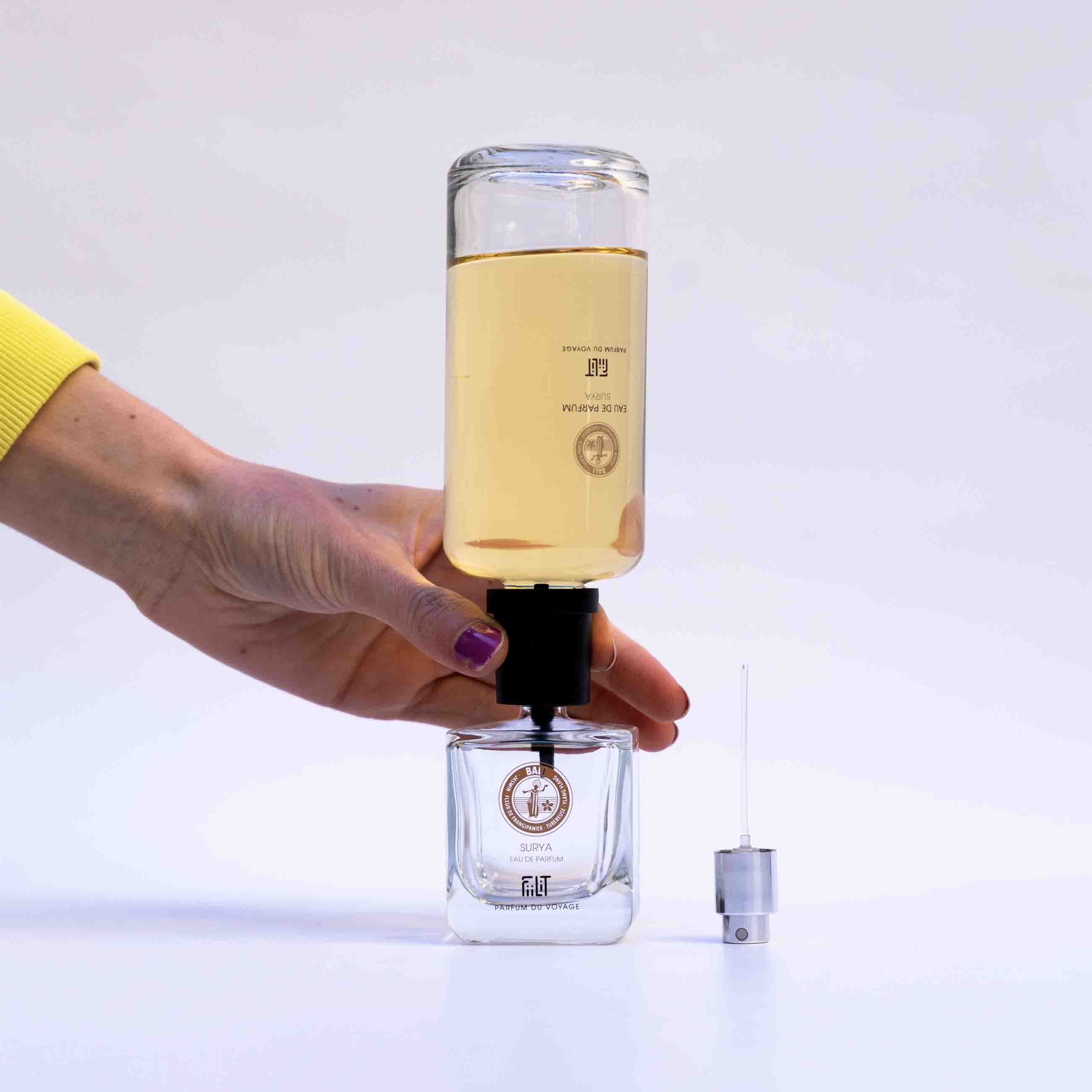
To fill the 11 ml travel bottle or the 50 ml bottle with a 200 ml refill, follow these steps:
1. Unscrew the pump of the refillable 50 ml or 11 ml bottle, counter-clockwise (to the left).
2. Screw the "funnel" tip of the refill onto the bottle to refill, clockwise.
3. Once screwed on tightly, the bottle fills by itself thanks to the air intake. If it does not fill immediately, shake the refill gently to help the perfume flow down. Wait until the bottle is full. When there are no more bubbles in the refill, filling is complete.
4. Unscrew the refill by its tip, holding it firmly.
5. Screw the pump back onto your bottle. You are ready to wear it.
Note: when handling the refill, take care not to unscrew the "funnel" tip from its 200 ml bottle.
Store your refill away from light and heat to preserve the quality of your perfume.
200 ml refill, built-in RT Twist tip:
- Very easy to use, anti-overflow system.
- Refills 11 ml and 50 ml bottles.
- Ideal for clean, quick refills.
- Economical and responsible format.
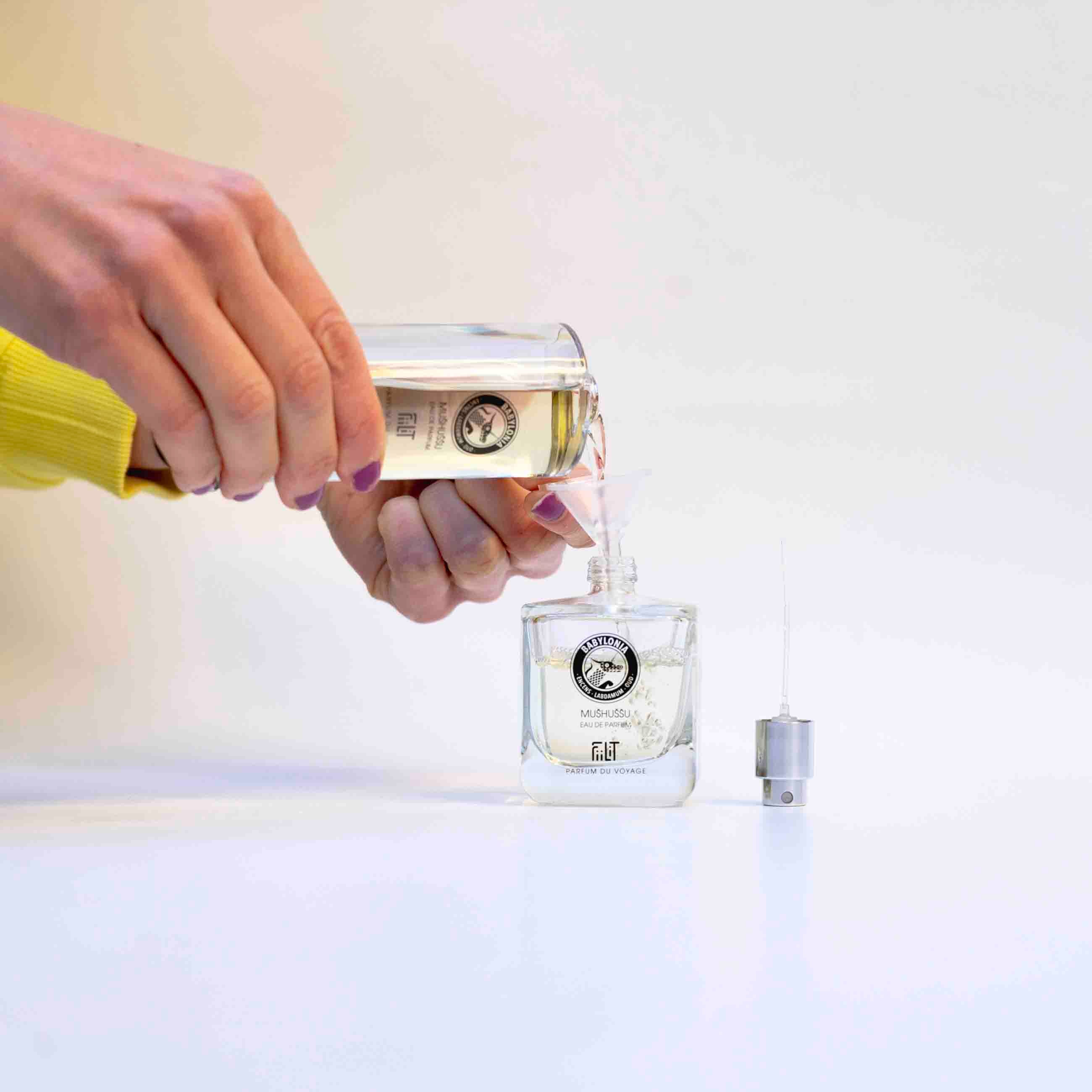
100 ml refill, with funnel:
- Also fills 11 ml and 50 ml bottles.
- Trickier to handle: higher risk of spilling with the funnel.
- Best if you are comfortable decanting by hand.
- Economical and responsible format.
Refills reduce your environmental impact while offering a durable, economical solution. A responsible way to enjoy your favourite fragrance to the full.
How many refills can I make? 200 ml ≈ 4×50 ml or 18×11 ml; 100 ml ≈ 2×50 ml or 9×11 ml.
To fill the 11 ml travel bottle or the 50 ml bottle with a 200 ml refill, follow these steps:
1. Unscrew the pump of the refillable 50 ml or 11 ml bottle, counter-clockwise (to the left).
2. Screw the "funnel" tip of the refill onto the bottle to refill, clockwise.
3. Once screwed on tightly, the bottle fills by itself thanks to the air intake. If it does not fill immediately, shake the refill gently to help the perfume flow down. Wait until the bottle is full. When there are no more bubbles in the refill, filling is complete.
4. Unscrew the refill by its tip, holding it firmly.
5. Screw the pump back onto your bottle. You are ready to wear it.
Note: when handling the refill, take care not to unscrew the "funnel" tip from its 200 ml bottle.
Store your refill away from light and heat to preserve the quality of your perfume.
200 ml refill, built-in RT Twist tip:
- Very easy to use, anti-overflow system.
- Refills 11 ml and 50 ml bottles.
- Ideal for clean, quick refills.
- Economical and responsible format.
100 ml refill, with funnel:
- Also fills 11 ml and 50 ml bottles.
- Trickier to handle: higher risk of spilling with the funnel.
- Best if you are comfortable decanting by hand.
- Economical and responsible format.
Refills reduce your environmental impact while offering a durable, economical solution. A responsible way to enjoy your favourite fragrance to the full.
How many refills can I make? 200 ml ≈ 4×50 ml or 18×11 ml; 100 ml ≈ 2×50 ml or 9×11 ml.
All of them, except the limited-edition 50 ml and the 1.5 ml sizes.
We carefully pack your perfumes as quickly as possible after your order (usually one working day). Once your parcel has shipped, you will receive an email to track it. Delivery time depends on your location (about 3 working days for France, 4 to 5 days for neighbouring countries, one week to 10 days for the rest of the EU and about 2 to 3 weeks for international destinations such as the US, Canada or South Korea).
Important note
We are a niche perfume house that cares deeply about the quality and originality of our creations. We believe perfumes are personal and unique expressions that can evoke intense, captivating emotions. This uniqueness can also mean that our fragrances do not suit every taste. We therefore recommend trying our products before buying, to find the perfumes that best match your personality and olfactory preferences. To discover them on your skin, try our Discovery Set.
Buyer protection
You have 14 days from receipt to return a product in its complete original packaging. You may open it to look at it, but not use it: if the contents have been used, taken out or refilled, the depreciation is deducted from the refund. Return costs are at your expense (tracked registered shipping, or a return label paid through a payment link we send you) and we refund you on receipt, including the initial delivery costs. Damaged or wrong product: send us a photo, and the return costs are then at our expense. Unsure? Add the 1.5 ml mini format to try it before using a full bottle. Learn more
All our eaux de parfum are unisex, 87% to 100% of natural origin.
Refillable bottles : 50 ml / 11 ml with wooden travel case / 11 ml on its own
The wooden travel case comes with its 11 ml fragrance.
Non-refillable bottles : limited-edition 50 ml and 100 ml
Made in : France
Vegan fragrance : yes, brand listed by PETA
Long-lasting on skin : yes
Readable formula : full ingredient list (INCI) on every product page
Composition : alcohol, essential oils, absolutes and natural extracts, completed in some fragrances by a few carefully chosen synthetic molecules
Concentration : eau de parfum
Age group : adult
Gender : unisex (for men and women)
Packaging : reusable and recyclable glass bottle, non-recyclable spray pump, ash-wood cap from France, Spain and Belgium, PEFC certified. The 11 ml bottle always comes inside the wooden travel case.

